

Gestalt therapy in Ukraine has been developing rapidly over the past twenty years. The number of training programmes grows noticeably every year, which means the number of certified and accredited gestalt therapists is also increasing.
This situation is driven by a pronounced societal demand for psychotherapy, which has grown significantly since the beginning of the full-scale war.
The exact number of gestalt therapy specialists is unknown, and no one has studied this topic. However, it can be said with certainty that the count runs into thousands, and perhaps tens of thousands. Naturally, there is a wide range of pricing for gestalt therapy services.
In private conversations, colleagues have repeatedly expressed the need for a clear understanding of the financial side of our profession: how the cost of psychotherapy services is set, what it depends on, what prices colleagues charge, how much gestalt therapists actually earn, etc.
Based on this need, this study of working conditions of gestalt therapists was conducted, with the aim of creating a clearer understanding of the gestalt therapy services market.
By the term "gestalt therapists" in this study we mean those people who indicated that they practise gestalt therapy with clients. This includes both certified and accredited specialists, as well as students of gestalt therapy training programmes who have begun their practice.
Between 19 June and 15 July 2024, 194 people were surveyed who indicated that they are practising gestalt therapists (either studying or having completed training). The survey was conducted in Ukrainian and concerned gestalt therapists of Ukrainian origin (living in Ukraine or abroad). Gestalt therapists from various institutes, of different ages and genders, and with different levels of experience were surveyed.
Special thanks go to the National Association of Gestalt Therapists of Ukraine (NAGTU) and the Kyiv Gestalt University (KGU) for posting information about this study and helping to attract respondents.
194 people took part in the survey, of whom 87% were women and 13% were men.
Among the respondents, 138 people permanently reside in Ukraine (71%) and 56 live abroad (29%).
Among those living in Ukraine, the majority reside in Kyiv - 68 people (49%), in regional centres - 26 people (19%), in other cities - 36 people (26%), and in villages or urban-type settlements - 8 people (6%).
Among those living abroad, only 20% lived there before the start of the full-scale invasion; 80% began living abroad after the start of the major war.
The vast majority of respondents have higher education (99%), 6% also hold a scientific degree, and 1% have secondary education.
Only 10% do not have an academic psychology degree, 78% do, and 12% are in the process of obtaining one.
74% of gestalt therapists are either married (52%) or in a civil partnership (22%).
Regarding gestalt therapy education specifically, the distribution is as follows:
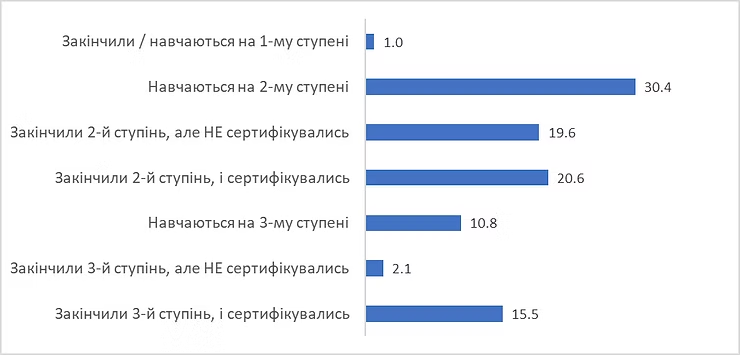
Additionally, 37% indicated that they have at least one additional psychotherapy qualification in another modality, and 6% are in the process of obtaining one.
Most therapists indicated that their session duration is either 50 min (45%) or 60 min (40%); 15% conduct 55-minute sessions. Interestingly, therapists with 50-minute sessions earn more than others.
73% of therapists indicated that they work either exclusively online (43%) or predominantly online (30%).
An interesting fact: only 92% of people indicated that they provide individual psychotherapy. 8% of gestalt therapists do not provide individual psychotherapy sessions (presumably they work with groups or provide other psychotherapy services).
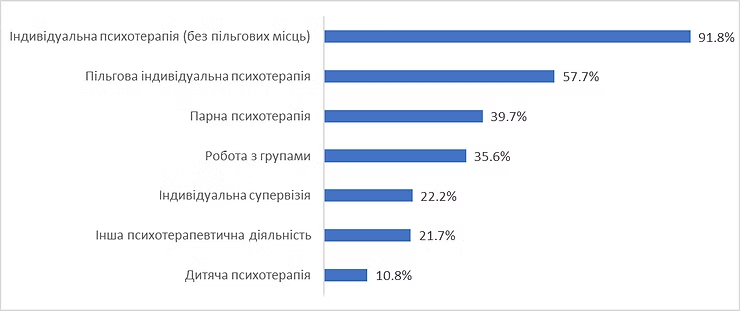
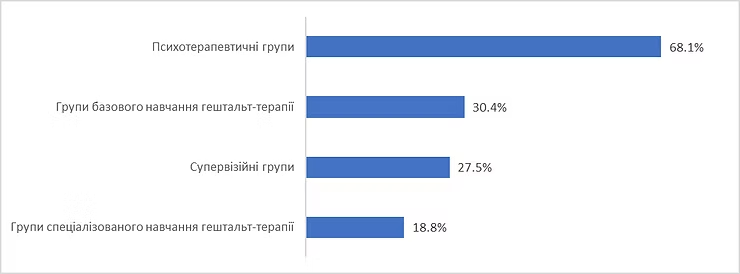
Among respondents, 22% provide individual supervision, 40% conduct couples counselling, and only 11% of therapists work with children. 36% work with groups (24% lead therapy groups, 8% supervision groups, 11% conduct basic training groups, and 7% run specialisations).
58% of therapists, in addition to standard fees, also provide individual psychotherapy on preferential terms. Accordingly, 42% do not work on preferential terms.
90% of respondents said that in the past 3 months they had attended a personal therapist, with the majority going once a week (70%). On average, they pay 1,600 UAH ($40) for their own therapy, which is more than gestalt therapists on average charge for their own sessions (1,200 UAH, or $30).
Individual supervision is also frequently attended - 86% of respondents attended it in the past 3 months. Most commonly, they attend twice a month (55%). On average, one supervision session costs the therapist 1,800 UAH ($45), which is more than the average therapist charges for providing supervision (1,500 UAH or $38).
Interestingly, the number of clients a gestalt therapist has does not depend on whether they attend their own personal therapist or supervisor. Although the quality of work probably differs significantly.
Moreover, those who attend a personal therapist earn less on average per month than those who do not (45,000 UAH and 60,000 UAH respectively). This is an interesting fact that requires further research.
As for session pricing, the situation is different. Those who attend a personal therapist and those who do NOT charge the same on average per session (1,200 UAH). However, those who do NOT attend a supervisor charge less (1,000 UAH) than those who do (1,200 UAH).
Therapists who attend supervision earn noticeably more per month (50,000 UAH) than those who neglect supervision (35,000 UAH). This is likely because attending a supervisor improves the quality of work, meaning more clients book with such a therapist.
It should be noted that all amounts in the survey were given in hryvnias. In this article, we will indicate the hryvnia value (as stated by respondents), as well as an approximate dollar equivalent (for convenience, using an exchange rate of 40 hryvnias per 1 dollar). We decided to include dollar values so that this data does not lose relevance if the hryvnia exchange rate changes.
The average earnings of psychotherapists are 49,500 UAH ($1,240). At the same time, 50% of respondents earn between 20,000 ($500) and 86,000 UAH ($2,150).
This is total earnings including all types of income from psychotherapy activities: both individual and group.
Among respondents, 73% indicated that psychotherapy is their main source of income.
The average cost of an individual psychotherapy session (excluding preferential rates) is 1,200 UAH ($30). On average, gestalt therapists have 10 sessions per week.
Supervision costs more - 1,500 UAH ($38). On average, colleagues provide 2 supervision sessions per week.
The average cost of couples therapy is 2,150 UAH ($54) and is provided once a week. Sessions typically last 90 minutes.
Child therapy costs 950 UAH ($24) and most commonly lasts 50 minutes. Therapists indicated that they provide an average of 2 child consultations per week.
Interestingly, the average cost of child consultations is lower than the average cost of individual adult psychotherapy. The number of gestalt therapists who work with children is also quite small (only 11% of those surveyed). It seems that this service is underdeveloped and has good growth potential.
Many factors affect how much a gestalt therapist earns from one specific group: the group's fee, its duration, the number of participants, whether the group is co-facilitated or not, whether there are advertising/office costs, etc.
Therefore, our questions did not cover all working conditions. The focus was specifically on how much a gestalt therapist earns net from conducting one specific group. The average earnings are given among those respondents who provide the services listed below.
35% of respondents (69 people) indicated that they conduct group psychotherapy activities.
24% of gestalt therapists conduct therapy groups. From one therapy group session, a gestalt therapist earns 3,500 UAH ($88), conducting 3 group sessions per month.
As for supervision groups, 10% of colleagues conduct them. The facilitator earns an average of 6,000 UAH ($150) per group session, conducting 2 groups per month.
A trainer conducting basic training groups earns an average of 30,000 UAH ($750) per group, conducting 1.5 groups per month. 11% of gestalt therapists conduct such groups. By basic training, we mean groups of levels 1, 2 and 3.
Specialisation facilitators earn the most - 39,000 UAH ($975), conducting an average of 1 specialisation per month. But the number of specialisation facilitators is the smallest - 7% of all respondents.
In addition, 8% of gestalt therapists indicated that they earn income from online psychotherapy activities. For example: conducting webinars, selling psychotherapy courses, online marathons, and other similar commercial psychotherapy activities on the internet. The average income from such activities is 10,000 UAH ($250).
A quarter of gestalt therapists (25%) also indicated that, in addition to the services listed above, they earn an additional 20,000 UAH ($500) on average from other psychotherapy activities.
Training programme facilitators in our survey are trainers who conduct first, second, and third level gestalt therapy training or specialisations. They stand out among other categories of gestalt therapists, so we will discuss them separately.
These are typically experienced psychotherapists with an average of 14 years of practice (ranging from 5 to 30 years). The average age is 46.
The average cost of a psychotherapy session with trainers is 2,200 UAH ($55). The average cost of supervision is slightly lower, at 1,900 UAH ($48).
The total average monthly income for trainers is 123,000 UAH ($3,075), with those who lead specialisations earning slightly more - 135,000 UAH ($3,375). The minimum earnings are 50,000 UAH per month ($1,250), the maximum - 300,000 UAH ($7,500).
On a five-point scale, the average level of satisfaction with their earnings among trainers is 4.2 points.
It is also worth noting that among training programme facilitators, the percentage of men is significantly higher (34%) than among gestalt therapists overall (13%).
57% accept payment via bank card, 55% to a sole proprietor account, 30% in cash, and the remaining 7% receive money in other ways (it is important to note that multiple answers could be selected). There is also a logical pattern: therapists who earn more tend to accept payment via a sole proprietor account more often.
When asked to rate satisfaction with their earnings on a 5-point scale (where 5 points = fully satisfied), respondents answered as follows:
40% of gestalt therapists are either fully or almost fully satisfied (11% and 29% respectively); 30% are either fully dissatisfied or simply dissatisfied (11% and 19% respectively); 30% gave 3 points - meaning their satisfaction is at an average level.
According to the survey, there is a direct correlation between a psychotherapist's satisfaction with their earnings and the cost of their individual session and overall income.
If we combine the data from all 194 respondents, we can compile a typical average profile of a gestalt therapist.
She is a 40-year-old woman with a higher psychology degree who has completed gestalt therapy training and has been practising for 5 years. This is her main source of income. On average, she sees 10 clients per week, charging 1,200 UAH per session. Plus 2 preferential clients to whom she offers a discount of 20 to 50 percent. She also provides other types of psychotherapy services, 2 sessions per week. In addition, she conducts 3 group sessions per month, earning a total of 3,500 UAH from each session. From this activity, she earns 49,500 UAH per month.
She also attends her own therapist once a week and a supervisor once every two weeks. She pays them more than she charges for her own services: 1,600 UAH for therapy and 1,800 for supervision.
We decided to divide these profiles as follows: beginner psychotherapists (up to 3 years of practice), mid-level psychotherapists (3 to 8 years of practice), and experienced psychotherapists (more than 8 years of practice).
According to our survey, there is. On average, men conduct slightly more sessions per week (12) than women (10).
Men charge slightly more per session (1,300 UAH) than women (1,200 UAH).
Moreover, total earnings from psychotherapy also differ. Men on average earn twice as much (!) as women - 80,000 UAH versus 40,000 UAH.
On average, gestalt therapists living abroad earn 1.5-2 times more from group activities than those in Ukraine.
Among those living in Ukraine, a higher percentage have 15 clients per week (82%). Therapists abroad more often have up to 7 sessions per week (36%) and up to 14 sessions (35%), rather than 15 or more sessions (18%).
Among those who lived abroad BEFORE the start of the full-scale invasion, the percentage of people with 15 or more clients per week is higher than among those who left after the start of the full-scale war. And the session fee of "old" emigrants is higher than that of "new" ones (1,500 vs. 1,165 UAH). This may indicate that two and a half years is not enough for emigrants to build a robust practice abroad.
Psychotherapists in Kyiv earn more than in other cities. Average earnings in Kyiv are 60,000 UAH ($1,500); regional centres - 55,000 UAH ($1,375); cities - 45,000 ($1,125); urban-type settlements - 49,000 UAH ($1,225); villages - 36,500 UAH ($913).
Overall, gestalt therapists who moved abroad after the full-scale invasion face difficulties building an individual practice. At the same time, those emigrants who lead groups fare better than their colleagues in Ukraine - they have more groups and higher income from groups.
Basic education affects the price of psychotherapy. 90% of therapists in our survey have a full higher education, and their average session fee is 1,200 UAH. Those with a scientific degree (6% of respondents) charge one and a half times more - 1,900 UAH.
There is a direct correlation between the level of gestalt therapy education and the number of sessions per week. A second-level student has on average fewer clients (6) than a certified therapist (9) or a third-level student (15).
If you are certified as a gestalt therapist, is it worth pursuing the third level? Yes. Certified gestalt therapists charge an average of 1,200 UAH for therapy. Those studying at the third level charge 1,500 UAH, and those who have completed it charge 1,800 UAH.
Years of practice also matter - the more years, the more clients per week. On average: up to 3 years - 6 clients, 3 to 8 years - 10, and more than 8 years - 15 clients.
The average cost of gestalt therapy services in Ukraine and abroad does not differ. However, the average cost of services within Ukraine varies significantly depending on the place of residence. Predictably, prices are higher in Kyiv (1,350 UAH) than in other cities (1,200 UAH). Interestingly, in villages the cost is slightly higher than in cities (1,250 UAH), and the highest cost is observed in urban-type settlements (as high as 1,800 UAH). This is probably related to the phenomenon of internal displacement of specialists.
The study of working conditions of gestalt therapists shows that specialists in this field have competitive pay. Given the good working conditions (the ability to work online, a flexible schedule), as well as the strong societal demand for psychotherapy services, more and more people are choosing the speciality of gestalt therapist. And all conditions exist for this trend to continue (and even increase) in the coming years.
The number of graduates from gestalt therapy training programmes is quite large, and their number is increasing every year. At the same time, it is important to remember about the quality of training and to focus on producing specialists with a well-developed theoretical base and practical skills to help clients.
All Research